
A commercial public address system often carries several audio sources over the same amplifier and loudspeaker network. Background music supports normal operation, paging delivers service information, and emergency broadcast communicates urgent instructions.
PA system priority levels determine which audio source takes control when two or more signals are active. A properly configured priority structure improves speech intelligibility, reduces operator delay, and ensures that critical messages are heard.
For clarity, Priority 1 is treated as the highest level below. Some PA platforms may use different numbering conventions.
| Priority | Audio Source | Typical System Response |
|---|---|---|
| Priority 1 | Emergency broadcast | Overrides paging and BGM |
| Priority 2 | Routine paging | Mutes or ducks BGM in selected zones |
| Priority 3 | Background music | Operates during normal conditions |
Priority 3: Background Music
Background music (BGM) is typically the lowest-priority audio source. It can be distributed to one or multiple zones and is automatically muted or ducked when paging or emergency messages are activated.
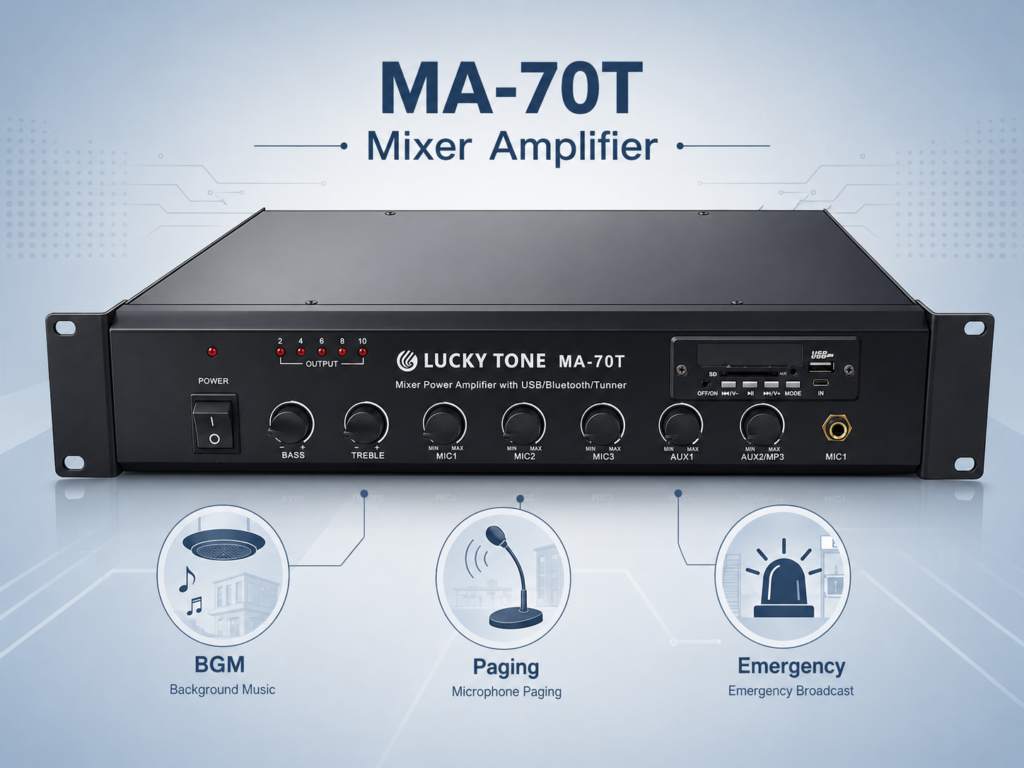
For smaller commercial installations, Lucky Tone MA Series Mixer Amplifiers support multiple music sources, Mic 1 priority, emergency microphone priority, and automatic muting for announcements.
Priority 2: Routine Paging
Routine paging includes staff calls, customer announcements, closing notices, scheduled messages, and general operational information.
In a multi-zone PA system, the paging operator should be able to select:
- One zone
- A group of zones
- All zones
When paging starts, BGM should be interrupted only in the addressed zones whenever possible. Music can continue in unaffected areas and return automatically after the announcement ends.
Lucky Tone zone paging microphones provide zone selection, talk control, and pre-announcement chime functions. The 10 Zone All-in-one System supports programmed or manual zone control, scheduled audio playback, and remote paging for small to medium PA projects.
For projects requiring more flexible routing, the Matrix Amplifier with Dynamic Power Sharing integrates audio matrix functions and supports background music, paging, emergency broadcast, remote wall panels, and paging stations.
Priority 1: Emergency Broadcast
Emergency broadcast is normally assigned the highest system priority. Once activated, it should override BGM and routine paging in the required zones.
An emergency broadcast may include:
- An alarm or attention tone
- A prerecorded evacuation message
- Live emergency instructions
- All-call or phased zone evacuation
Activation can be initiated manually or through an external fire alarm contact. In larger facilities, the system may broadcast first to the affected zone and then to adjacent zones according to a predefined cause-and-effect plan.
Lucky Tone’s D-EMP3 Emergency Panel supports external or manual alarm activation and can store recorded voice messages. The D-AMTX32 32-channel Alarm Matrix provides 32 contact inputs and outputs for fire alarm integration and supports configurable adjacent-zone triggering.
For higher system reliability, the EVAC-801 Intelligent Amplifier Changeover & Speaker Line Supervision Unit combines automatic backup-amplifier switching with eight-zone speaker-line monitoring and fault feedback.
Where emergency broadcasting forms part of a regulated voice-alarm or evacuation system, the complete design—including equipment, wiring, backup power, supervision, installation, and commissioning—must meet the applicable local codes and project requirements.
Key Priority Design Considerations
A reliable PA system should clearly define:
- The priority order of every audio source
- The zones available to each paging station
- Whether BGM is muted or ducked during paging
- How alarm contacts activate emergency zones
- How the system returns to normal operation
- How amplifier and speaker-line faults are monitored
For larger projects, these functions should be documented in a cause-and-effect matrix, showing how every paging command or alarm input affects each audio zone.
Conclusion
A clear priority structure allows one PA system to handle daily background music, operational paging, and emergency communication without signal conflicts.
Simple installations may require only a mixer amplifier with automatic microphone priority. Larger facilities benefit from zone paging stations, matrix routing, alarm interfaces, emergency message panels, amplifier redundancy, and speaker-line supervision.
Lucky Tone provides analog and digital-control PA products for building complete background music, paging, and emergency broadcast solutions across commercial buildings, schools, hotels, factories, transportation facilities, and public spaces.
Planning a PA project? Provide the number of zones, speaker load per zone, paging locations, BGM sources, and fire alarm interface requirements to receive a more accurate system proposal.