
What Are SIP and ONVIF Network Speakers?
SIP and ONVIF network speakers enable audio communication over IP networks, simplifying paging, announcements, and integration with other networked systems.
SIP (Session Initiation Protocol) manages communication sessions for IP paging, voice calls, and intercom applications. ONVIF supports interoperability between compatible IP-based security devices and management platforms, enabling integrated audio and security workflows where supported.
Lucky Tone offers network speakers supporting both protocols, providing flexible options for commercial PA, emergency announcements, and security-related audio applications.
SIP vs. ONVIF: Key Differences
Although both support IP-based audio applications, SIP and ONVIF serve different purposes.
SIP: Establishes communication sessions for paging, voice calls, and intercom functions through compatible SIP infrastructure.
ONVIF: Supports interoperability with compatible security systems and video management platforms, depending on the supported interfaces and functions.
- These protocols are complementary rather than mutually exclusive. Lucky Tone’s VOIP Series network speakers support both SIP and ONVIF, helping system integrators select suitable solutions for different project requirements.
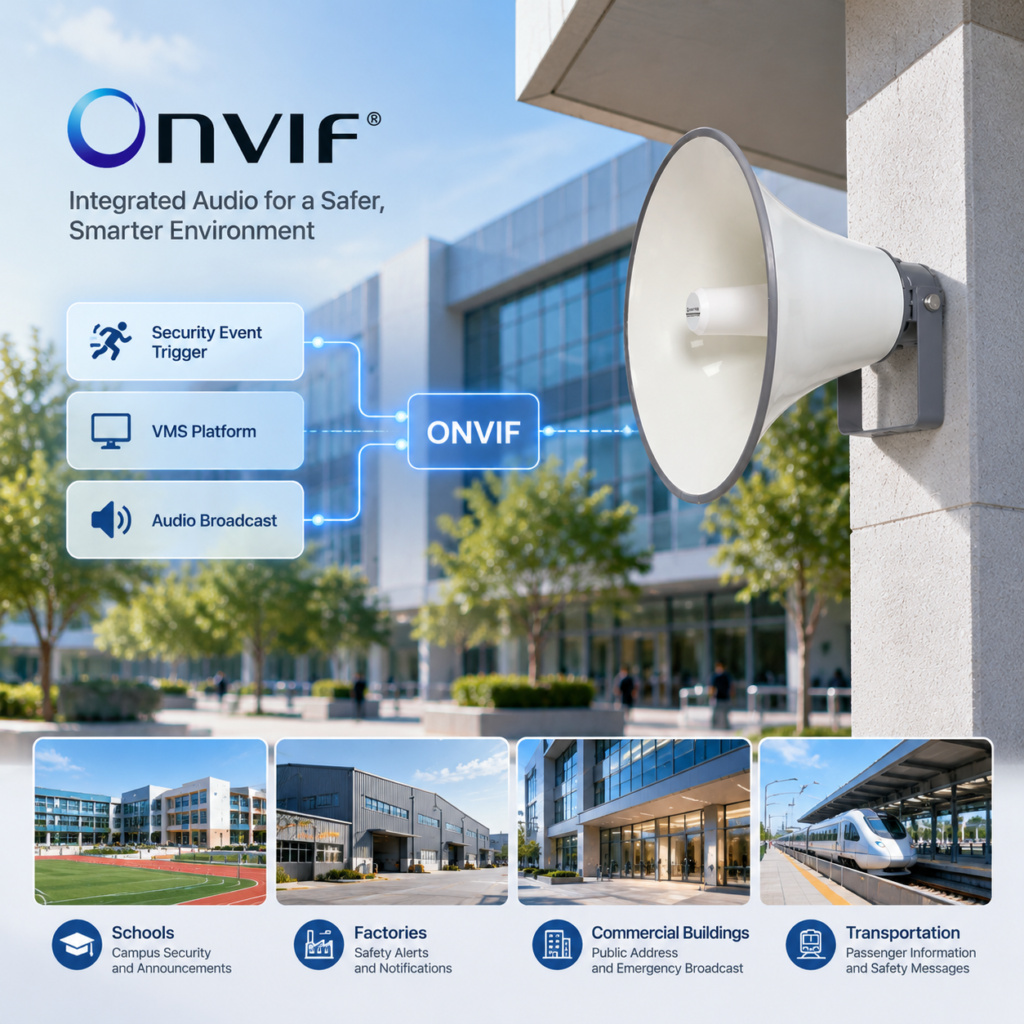
Lucky Tone Network Speaker Solutions
Lucky Tone provides network speakers in multiple form factors to accommodate different installation environments.
Horn Speakers — VOIP-15HR, VOIP-30HR, VOIP-60HR: Designed for high-output announcements in industrial facilities, outdoor areas, and transportation environments.
Ceiling Speakers — VOIP-15C: Suitable for indoor paging and announcements in commercial buildings.
Wall-Mounted Speakers — VOIP-30WM, VOIP-60WM: Designed for wall-mounted audio distribution in commercial and institutional spaces.
Projection Speakers — VOIP-20PJ: Suitable for focused audio coverage in warehouses, loading bays, and semi-outdoor areas.
Pendant Speakers — VOIP-30HG: Provide suspended audio coverage for suitable indoor environments.
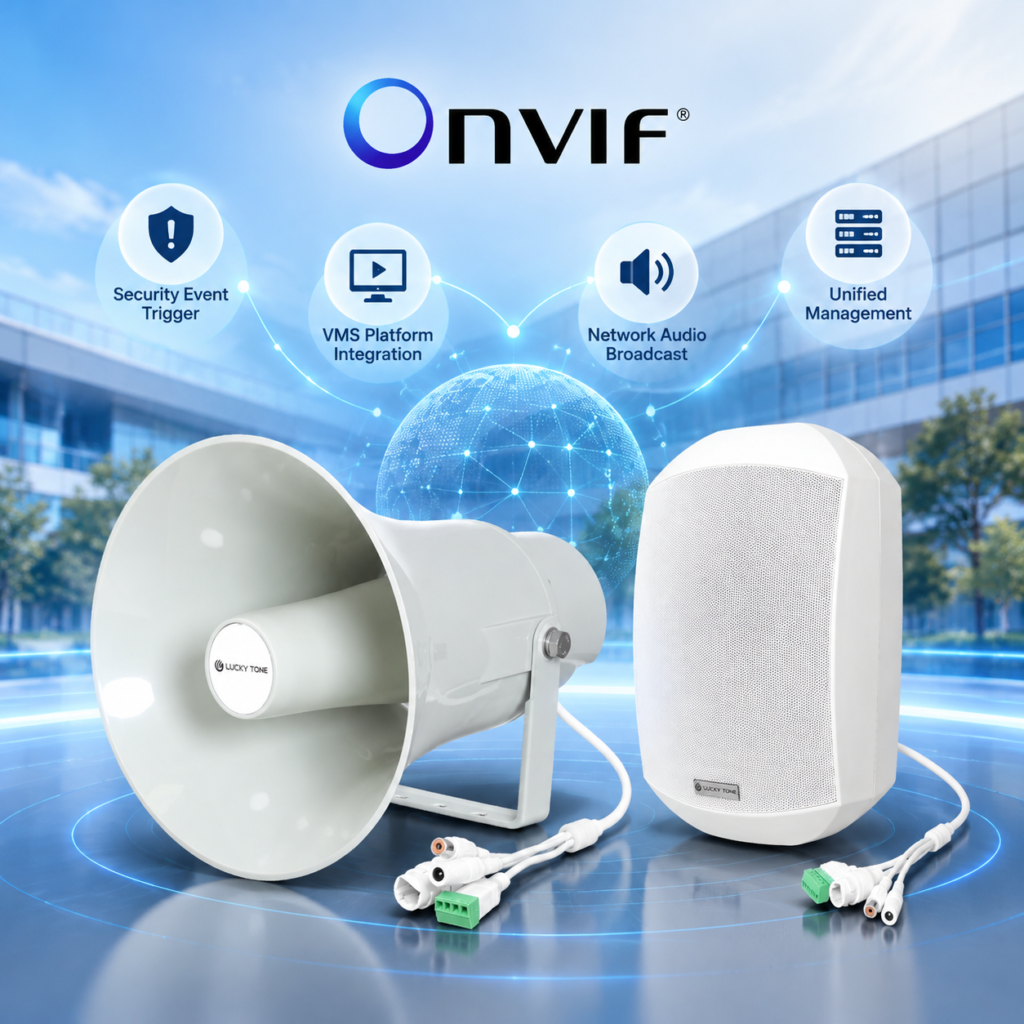
The VOIP Series supports SIP and ONVIF protocols, MP3/WMA/WAV audio decoding, and 10/100Base-TX Ethernet connectivity. Selected models support PoE and DC power, while outdoor-oriented models offer IP66 protection.
Explore Lucky Tone’s ONVIF Network Speakers for product options and specifications.
Integration with Commercial PA and Security Systems
When designing an IP audio system, protocol compatibility is only one part of the solution. Integrators should also consider network architecture, power requirements, speaker coverage, and control functions.
For SIP-based paging, verify compatibility with the existing SIP server, PBX, or communication platform. For ONVIF-based integration, confirm that the selected speaker and management platform support the required functions and event workflows.
For larger installations, network speakers can be incorporated into a broader IP PA solution alongside compatible SIP controllers, intercom devices, and ONVIF management tools. Proper configuration helps streamline system management across commercial buildings, campuses, factories, and transportation facilities.
Conclusion
SIP and ONVIF network speakers support different but complementary integration requirements. SIP focuses on communication sessions, while ONVIF facilitates interoperability with compatible security and management systems.
With its VOIP Series horn, ceiling, wall-mounted, projection, and pendant speakers, Lucky Tone provides flexible options for IP-based paging and commercial audio projects.
Planning an IP PA project? Contact Lucky Tone to discuss speaker selection, protocol compatibility, and system integration requirements.