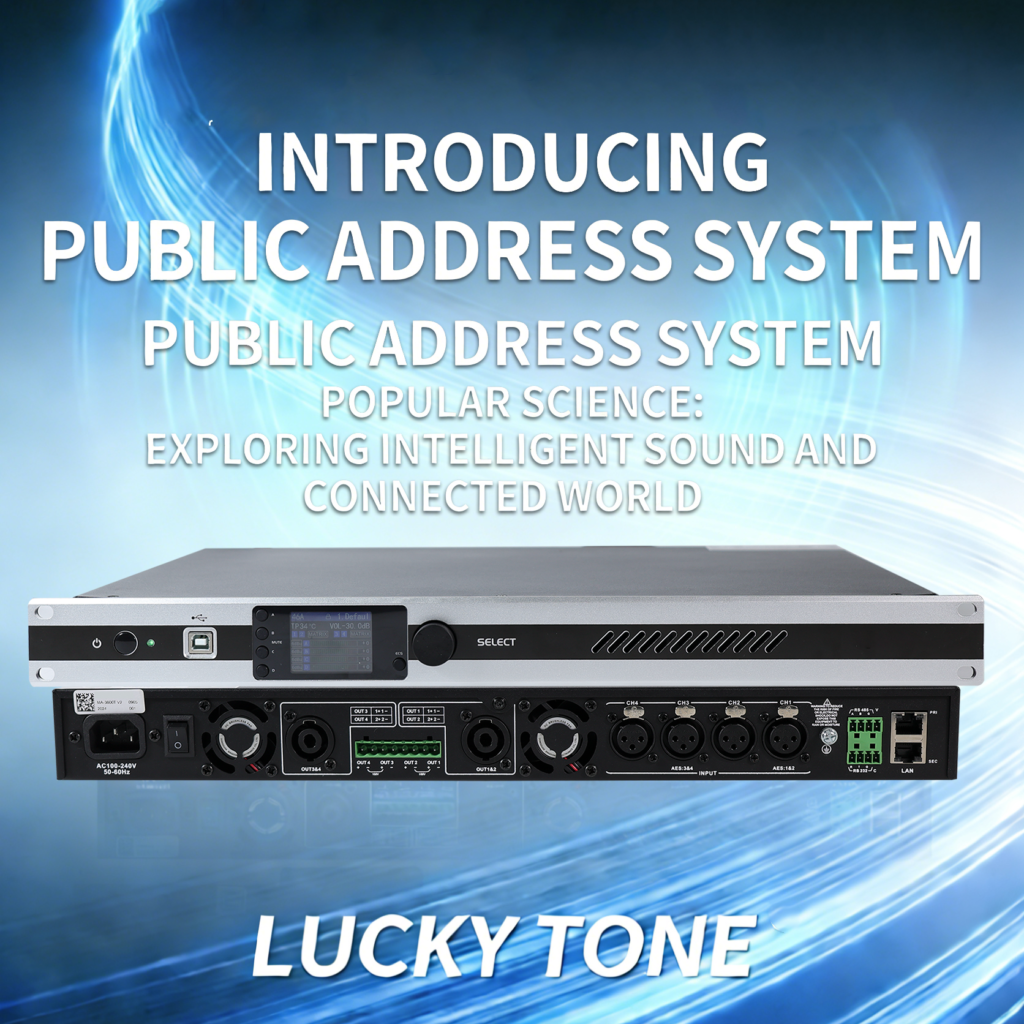
In modern commercial buildings, public address systems (PA systems) have become essential infrastructure. Whether in shopping malls, schools, airports, hospitals, industrial parks, or office buildings, PA systems play an important role in delivering audio communication such as announcements, background music, and emergency information.
When planning a PA system, system integrators and project planners often face a key question:
Should you choose an analog PA system or a digital network PA system?
Both technologies are widely used in commercial audio installations, but they differ significantly in system architecture, scalability, control capabilities, and long-term maintenance.
In this article, Lucky Tone explains:
* How analog PA systems work
* How digital and IP-based PA systems operate
* The key differences between the two technologies
* Which system is best suited for different project scenarios
What s a Public Address (PA) System?
A public address system is designed to amplify sound and distribute audio across multiple loudspeakers within a building or facility.
A typical commercial PA system includes:
* Microphones
* Mixer amplifiers or audio processors
* Power amplifiers
* Loudspeakers
* Control systems or paging consoles
PA systems are commonly used for:
* Background music (BGM)
* Public announcements
* School or corporate paging
* Multi-zone audio distribution
* Emergency broadcast systems
Based on system architecture, PA systems are generally divided into two main categories:
Analog PA Systems
Digital / IP Network PA Systems
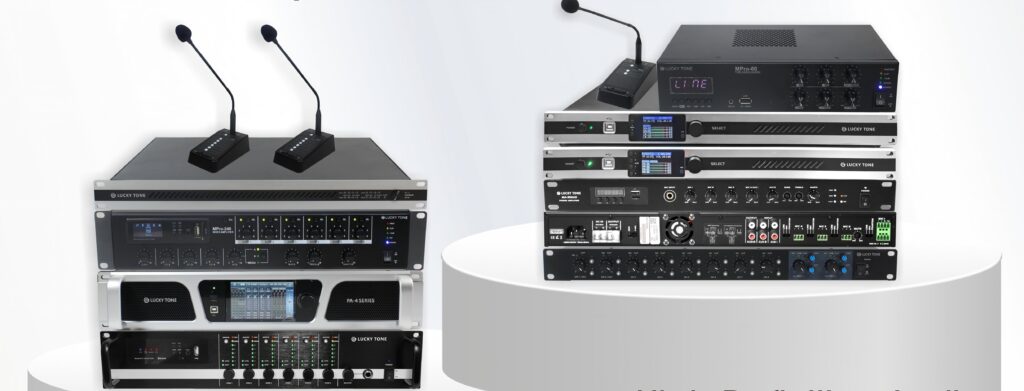
How Analog PA Systems Work?
Analog PA systems transmit continuous electrical audio signals from audio sources to amplifiers and loudspeakers.
In commercial installations, analog systems typically use 70V or 100V constant-voltage speaker lines, allowing multiple speakers to be connected over long distances while maintaining stable audio transmission.
Analog PA systems offer several advantages:
* Simple system architecture
* Easy installation and deployment
* Lower equipment cost
* Near-zero audio latency
For these reasons, analog PA systems are widely used in:
* Small commercial spaces
* Building renovation projects
* Basic announcement and background music systems
Lucky Tone provides a full range of analog PA solutions, including mixer amplifiers, zone controllers, and commercial loudspeakers, widely used in retail stores, schools, restaurants, and office environments.
How Digital PA Systems Work?
Digital PA systems convert audio signals into digital data using digital signal processing (DSP), and transmit the audio through Ethernet or IP networks.
This system architecture enables advanced features such as:
* Multi-zone audio management
* Scheduled audio playback
* Remote monitoring and control
* Audio equalization and processing
* Integration with emergency broadcasting systems
In large projects, Dante audio networking is often used to transmit professional audio signals over standard network infrastructure with high reliability.
Lucky Tone’s digital PA solutions include DSP mixer amplifiers, IP network PA systems, Dante audio systems, and PoE network speakers, designed for large commercial buildings, campuses, and smart building projects.
Analog vs Digital PA Systems: Key Differences
| Feature | Analog PA System | Digital / IP PA System |
| Signal Transmission | Analog audio signals | Digital audio over IP or Ethernet |
| Audio Stability | More susceptible to interference | DSP-processed, stable audio |
| Zone Control | Limited zone control | Flexible multi-zone management |
| Scalability | Expansion requires additional wiring | Easily scalable via network |
| Installation | Simple wiring | Requires network configuration |
| Maintenance | Manual on-site troubleshooting | Remote monitoring and diagnostics |
| Ideal Applications | Small buildings or retrofit projects | Large commercial facilities |
Scenario-Based System Selection Guide
| Project Type | Recommended System | Typical Applications |
| Building Renovation | Analog PA System | Schools, factories |
| Small Commercial Spaces | Analog PA System | Shops, restaurants |
| Real-Time Paging | Analog PA System | Construction sites, event venues |
| Large Commercial Buildings | Digital PA System | Shopping malls, office buildings |
| Campuses and Industrial Parks | IP Network PA | Airports, hospitals |
| Conference Centers | Dante Audio Systems | Meeting rooms |
| Multi-Location Businesses | Network PA System | Hotels, retail chains |
Typical Applications of Public Address Systems
Public address systems are widely used across many commercial and public environments, including:
* Shopping malls and retail spaces
* Airports and transportation hubs
* Schools and educational institutions
* Industrial parks and factories
* Hospitals and healthcare facilities
* Hotels and public buildings
Lucky Tone provides complete commercial public address system solutions, widely used in commercial buildings, educational institutions, and large public infrastructure projects.
Conclusion
Both analog and digital PA systems have their advantages.
Analog systems are suitable for smaller or retrofit projects, while digital and IP-based systems are better for large facilities and modern buildings.
Lucky Tone provides complete commercial PA solutions and technical support for global partners.